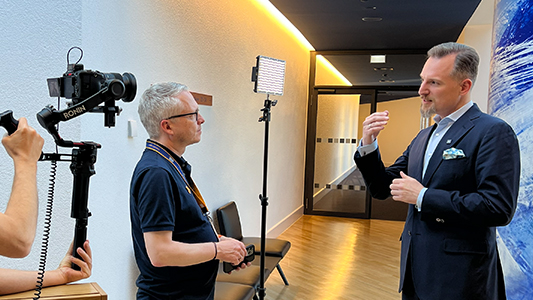
In a recent interview with ELO Digital Office , Dr. Alexander Swienty, Head of Channel Management at Insiders Technologies, discusses the evolution from traditional AI systems to Agentic AI. The focus is on how companies can effectively integrate AI agents into their organization and existing process landscape.
Unlike traditional AI, an AI agent is not merely assigned a single, clearly defined task but rather a role with its own set of responsibilities. For example, an agent can fully process a mixed inbox: classifying documents, forwarding them, organizing them, extracting relevant metadata, and verifying the quality of the results.
This makes one thing clear: Agentic AI is not a plug-and-play technology. Companies must understand their processes, data, and interfaces and prepare them accordingly.
Unlike traditional AI, an AI agent is not assigned just a single, clearly defined task, but rather a role with its own set of responsibilities. For example, an agent can fully process a mixed inbox: classifying documents, forwarding them, organizing them, extracting relevant metadata, and verifying the quality of the results.
This makes one thing clear: Agentic AI is not a plug-and-play technology. Companies must understand their processes, data, and interfaces and prepare them accordingly.
“It’s not about using AI to cover up poor processes and thereby mask them.”
Clean data, clear responsibilities, and transparent decisions are crucial prerequisites. After all, the more leeway an AI agent is given, the more important governance, transparency, and oversight become.
Alexander Swienty therefore compares the deployment of an AI agent to onboarding a new employee: Just like a new employee, an AI agent needs clear tasks, access to the right information, appropriate tools, and an understanding of the company’s processes.
The full interview highlights where concrete efficiency gains are already possible today, how collaboration between humans and AI will change, and what skills companies should be developing now.