IN-Career_06-1920x1080

    How many of your document processes still rely on someone correctly interpreting free-form text? Large language models understand, process, and generate natural language. That’s exactly why we use them for classification, extraction, and automation in document processing—they’re firmly integrated into our products.

    What is a large language model?

    A Large Language Model, or LLM for short, is an AI model that has been trained on very large amounts of text and has learned how language is structured. It recognizes patterns in phrasing, categorizes terms, and deduces what a text is about—without anyone having to provide it with fixed rules.

    For document processing, this is the key difference from traditional text recognition. A rule-based system requires a separate configuration for each invoice template. A language model, on the other hand, can understand even a document it has never seen in this form before—a complaint written in free-form language, an invoice with an unfamiliar layout, or a termination notice without a subject line.

    What matters here is not whether a model understands language. What matters is which model is used for which task, where it is deployed, and what happens to the data it processes.


    Compatible Model

    A single language model cannot perform equally well on every task. And relying on a single provider quickly becomes a risk, both technically and contractually. OvAItion therefore combines external and in-house language models and AI agents trained for document processing, depending on the use case.

    Privacy Policy

    With the latest OmnIA update, you can run LLMs entirely on your own infrastructure: preconfigured for document processing and with significantly lower server requirements than generic models. Those who opt for the Insiders Cloud, on the other hand, work in an environment certified to ISO 27001 and BSI C5 Type 2, with operations based in Germany.

    Legally sound

    Key provisions of the EU AI Act will take effect on August 2, 2026. The risk assessment for the use of large language models in document processing via our platform has already been completed: minimal risk, documented and verifiable based on the European Commission’s criteria. You do not need to conduct this assessment yourself.

    Knowledge and Action

    A large language model that understands a document is the first step. Agentic AI goes a step further and autonomously triggers the appropriate next steps based on that understanding. At Insiders, these two components build on each other.

    Why a Single Model Isn't Enough

    A single language model cannot handle every task equally well. And relying on a single provider quickly becomes a risk, both technically and contractually: prices change, models are discontinued, and interfaces break. That’s why OvAItion combines external and in-house LLMs and AI agents trained for document processing, depending on the use case.

    Extracting individual fields from an invoice doesn’t require a model that can write poetry. Conversely, a highly specialized extraction model is of little help when a customer complaint written in natural language needs to be categorized. The platform decides which model handles a task—not you.

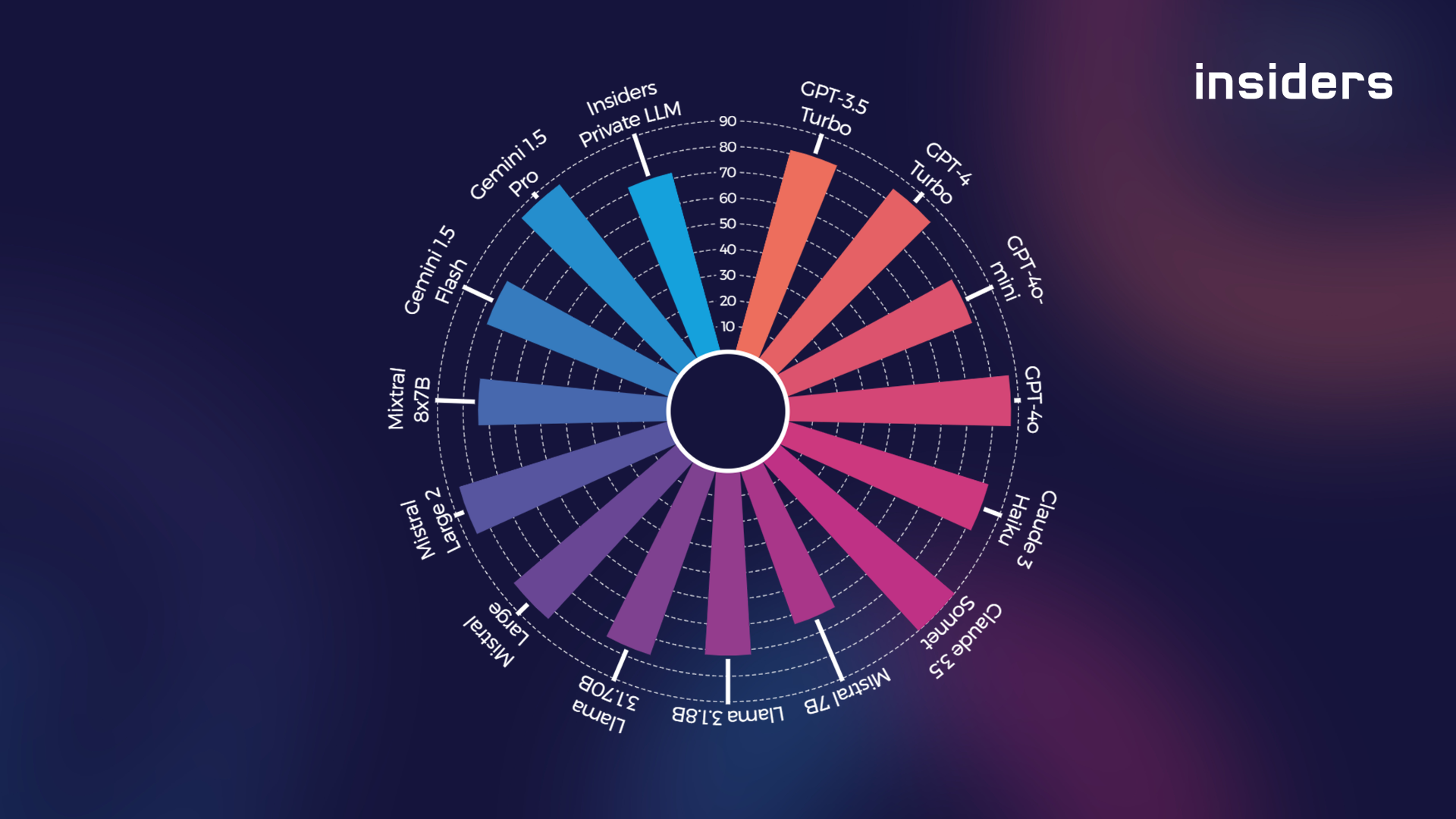
    LLM_Benchmarking_January_2025

    Where Large Language Models Are Already Being Used by Our Customers

    IL-download-document

    Classification & Extraction

    The system recognizes documents and automatically extracts specialized data, even from unstructured input.
    IL-controlling2-dollar

    Automatic Invoice Posting

    Large Language Models assign invoice line items to the correct accounts.
    IL Documents

    Layout and Table Recognition

    The system captures even complex, multi-page documents in a structured manner.

    Our Customers' and Partners' Success Stories

    AI in business boosts efficiency, reduces costs, and unlocks new opportunities for innovation in nearly every industry. Our customers’ use cases demonstrate how successful process optimization makes companies more efficient and innovative. By implementing intelligent solutions, they have been able to optimize their business processes and achieve sustainable competitive advantages. Let our success stories inspire you!

    2026-05-ing-insiders

    AI processes 7 million documents automatically

    Millions of documents from a wide variety of channels, rising demands for speed and automation — for ING, powerful input management is business-critical. With the AI-based platform OmnIA from Insiders Technologies, the direct bank succeeds in automatically processing large parts of its incoming mail, significantly shortening turnaround times, and sustainably relieving the burden on business departments.

    2026-05-bgv-insiders

    AI-powered classification boosts automation

    With the Cognitive Classifier from Insiders Technologies, BGV increases full automation in input management by 10 percentage points. With more than 650,000 incoming documents annually and around 95 percent average classification accuracy, BGV achieves a new level of quality in automated processing — providing noticeable relief for employees and stable processes even during peak periods.

    The EOS Main Building with the Company Logo

    Highly Automated Document Processing in Accounts Receivable Management

    Each year, EOS Deutscher Inkasso-Dienst processes approximately 2.5 million incoming documents—ranging from invoices and emails to handwritten notes. For automated classification, EOS relies on the OmnIA solution from Insiders Technologies, supplemented by the new Integration Layer for OCR (ILFO).

    Securely Orchestrating Agentic AI with OmnIA

    AI agents are increasingly planning, deciding, and acting independently – yet without central control, traceability is lost. OmnIA integrates agentic AI applications into your existing IT landscape in a controlled, explainable, and data-protection-compliant manner.

    Any questions?

    • Key provisions of the EU AI Act will take effect on August 2, 2026. The risk assessment for the use of large language models in document processing via our platform is already available: minimal risk, documented and verifiable based on the European Commission’s criteria. You do not need to conduct this assessment yourself.
    • With the latest OmnIA update, you can run LLMs entirely on your own infrastructure: preconfigured for document processing and with significantly lower server requirements than generic models. Your documents never leave your network.

      Those who opt for the Insiders Cloud, on the other hand, work in an environment certified to ISO 27001 and BSI C5 Type 2, with operations based in Germany. The BSI C5 certification is validated annually by an independent auditor—for your own audit requirements, this means you can refer to our audit rather than repeating it.
    • External models are available immediately and perform well on general language tasks. Private models run on your own infrastructure and never leave it. For most document-processing tasks, the right answer isn't an either/or decision, but rather a matter of categorizing data based on its sensitivity.

      Criterion External LLM On-Premises Private LLM
      Where data is processed At the model provider’s location In your data center or the Insiders Cloud (ISO 27001, BSI C5 Type 2, located in Germany)
      Setup effort Minimal, ready to use immediately Higher, but a one-time cost
      Ongoing costs Per request; increases with volume [PLEASE FILL IN: Server requirements and the volume at which in-house operation becomes cost-effective]
      Dependence on providers Price and model changes take effect immediately None—the model and version remain under your control
      Suitability General language tasks, free-form expressions Recurring document processes involving sensitive content
    • The model market is changing faster than selection decisions become outdated. That’s why we regularly evaluate the available language models based on what matters most in document processing: recognition accuracy, processing speed, and cost per document.

      We publish these results openly—most recently in December 2025. They are directly incorporated into the model selection process in OvAItion. If a new model performs better for a given task, you benefit from it without having to make any changes yourself.

    • Only if you want to. With OmnIA Self-Hosting, you run the language models entirely on your own infrastructure—the documents never leave your network. Alternatively, processing takes place in the Insiders Cloud, which is certified to ISO 27001 and BSI C5 Type 2 and operates in Germany.
    • Each transaction is assigned a confidence score. If the score falls below the threshold you have set, the transaction is routed for manual review rather than being processed automatically. In addition, rule-based checks ensure accuracy for values where precision is critical—such as amounts and account assignments.
    • Not for use via our platform. The risk assessment based on the European Commission’s criteria is documented: minimal risk. The key requirements of the regulation will take effect on August 2, 2026—we have already completed the assessment for document processing.
    • No. OvAItion combines various external and in-house models and selects the appropriate one based on the task at hand. If a provider changes its prices or discontinues a model, the system switches over automatically in the background—nothing changes for your processes.