From Academia to Product
Document processing sounds like a problem that’s already been solved. Capturing documents, understanding content, triggering processes—that should have been automated long ago. In reality, the devil is in the details: Every company has different document types, different layouts, and different fields. If you want to train an AI model that reliably recognizes the right information, you need data. A lot of data—and it has to be annotated: Employees have to manually review thousands of documents and mark which information the model should learn. That’s expensive, time-consuming, and a real bottleneck.
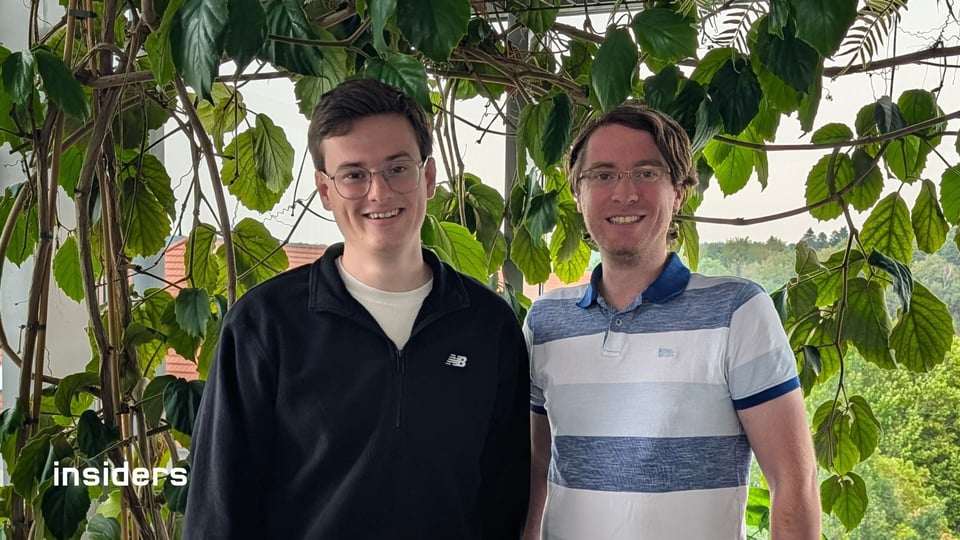
We solve challenges like these with scientific tools. In collaboration with the DFKI (German Research Center for Artificial Intelligence) under Didier Stricker, our student intern Nick Jochum developed an approach as part of his thesis that automates a large portion of this annotation effort. The technical core of the system: Label Propagation, an algorithm from the 1990s. The idea is to automatically infer the rest of the data from a small set of manually annotated documents. The result surprised even Nick: With just 10% of the data annotated, the model achieves 81% of the performance of a fully annotated dataset.
Publishing Is Part of It
Anyone conducting research at Insiders should be able to share their findings with the outside world. Nick will publish the method for automated annotation this year at ICDAR (International Conference on Document Analysis and Recognition), one of the world’s leading conferences on automatic document processing. The conference brings together researchers from universities and companies who are working on precisely the problems we deal with every day.
The submission was developed with the support of Tobias Alt-Veit, Alexander Lück, and René Schuster. Christian Schön guided the writing process and the revision from thesis format to a scientific publication. “The whole team gave me the space to focus on this work,” Nick recalls.
This was a deliberate decision. Anyone writing a conference submission alongside ongoing product operations needs an environment that makes this possible. Research work requires time and priority within the organization. At our company, both are factored into our plans because we want to learn from the scientific community and, at the same time, give something back.
From a Work-Study Position to a Full-Time Job
We give student workers real responsibilities. If someone demonstrates their potential, they’re given responsibility and the opportunity to continue working with us. Many stay on.
As a working student, Nick had a narrow focus. Today, he works full-time in a permanent position on the further development of the OvAItion DocumentSeparator and builds new applications using large language models and AI agents. What has changed is the scope of his tasks. What has remained the same, as Nick himself describes it, is the team, the culture, and the trust.
His decision to stay wasn’t a single, decisive choice. “There wasn’t a single moment when I decided, ‘This is where I want to work.’ It just sort of grew on me,” he says. That sounds like a solid foundation.