C5 Certification vs. ISO 27001: What Your Cloud Provider Really Needs to Be Able to Do
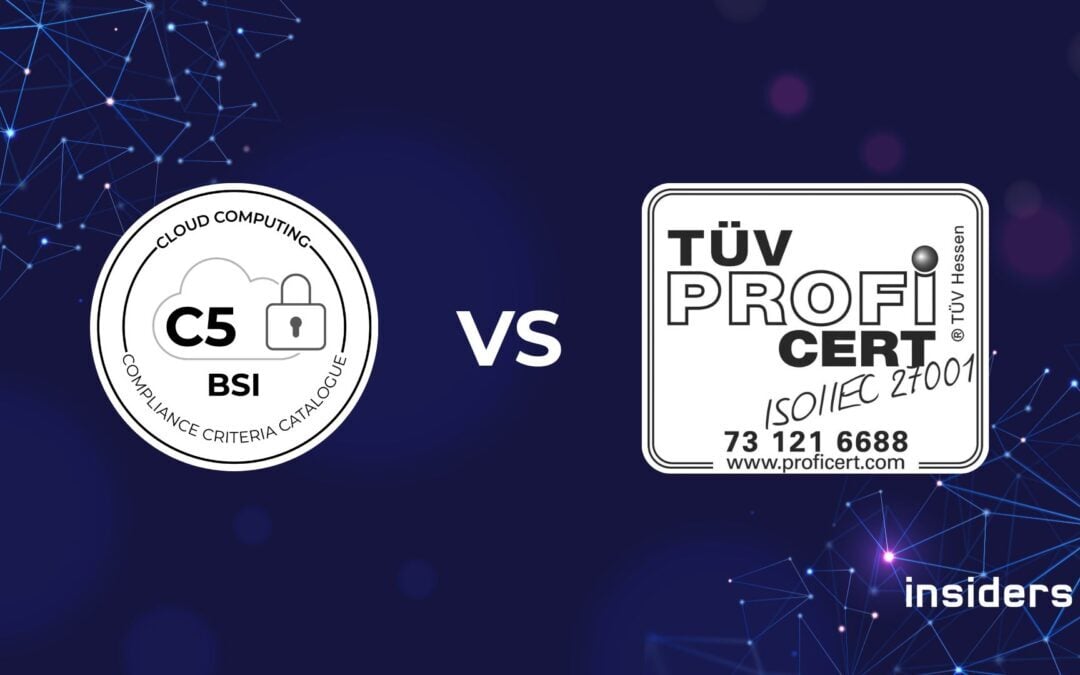
C5 Certification vs. ISO 27001 – What’s the Difference? While ISO 27001 certifies a general information security management system, the BSI C5 certification is specific proof of the operational security of specific cloud services over a period of 6–12 months.
Many IT managers rely on their cloud provider’s ISO 27001 certification. But be careful: While ISO 27001 validates the management system, only the C5 Type 2 attestation proves actual security in ongoing cloud operations. In the healthcare sector in particular, this has been a legal requirement since July 2025, rather than an option.
For companies in regulated industries, those with critical infrastructure, or public administration, the C5 certificate has now become the de facto standard. Yet very few decision-makers know the specific difference between the two certifications—and even fewer understand the significant compliance benefits a cloud provider offers with both certifications.
In this article, we highlight the fundamental difference between ISO 27001 and the C5 certification, explain why both standards are necessary for professional cloud services, and what specific benefits you, as a customer, can expect if your provider holds both certifications.
The fundamental difference: Information Security Management System vs. Cloud Operational Security
ISO 27001 and the C5 certification are often mentioned in the same breath, but they pursue completely different goals. This difference is crucial for your compliance strategy.
ISO 27001 says: “We manage security properly.”
The international standard ISO 27001 defines the requirements for an information security management system. The certificate attests that a company effectively operates this system. The focus is on processes, responsibilities, a risk-based approach, and continuous improvement. ISO 27001 is industry- and technology-neutral—any company can obtain certification, whether it offers cloud services, is a manufacturing company, or operates in the retail sector.
The certification assesses the maturity and effectiveness of the existing management system. Among other things, it documents that risks are systematically identified, assessed, and addressed. Policies, processes, and responsibilities are defined for the organization.
C5 Type 2 states: “This specific cloud service is demonstrably operated securely.”
The C5 certification from the Federal Office for Information Security was developed specifically for cloud services. It assesses not only the company’s management system but also specific cloud services and their technical controls. This means that a certified public accountant confirms that specific cloudapplications have continuously met the BSI’s 121 security criteria over an audit period of 6 to 12 months.
The key difference lies in the required measures and the level of detail in their technical implementation. While ISO 27001 requires that measures for the secure processing of data be implemented, C5 Type 2 demonstrates that the specific measures required in the catalog are met and remain effective on an ongoing basis —with evidence from real-world operations. C5 is more comparable and specific in this regard; ISO 27001 allows for more organization-specific flexibility in implementation.
Direct Comparison: C5 Certification vs. ISO 27001
| Criterion | BSI C5 Type 2 | ISO 27001:2022 |
| Type of Certification | Certificate (Test Report) | Management System Certification |
| Focus | Specific cloud services and their operation | Organization and processes (within the defined scope) |
| Scope of the Audit | Technical and organizational cloud controls | Information Security Management System |
| Type of company | Specific to cloud service providers | Industry- and technology-independent |
| Target Audience | Cloud service providers | All organizations (including non-cloud providers) |
| Test logic | Effectiveness of controls in operation over 6–12 months | Maturity and effectiveness of the management system |
| Audit criteria | 121 criteria in 17 control areas | 93 controls in Appendix A (plus Chapters 4–10) |
| Audit cycle | Annual testing is standard practice | 3-year cycle with annual surveillance audits |
| Implementation | Auditors in accordance with ISAE 3000 / IDW PS 951 | Accredited certification bodies |
| Significance for the cloud | Very high – cloud-specific | Fundamental – general security management |
Comparison: BSI C5 Type 2 vs. ISO 27001 Certification
The key point: ISO 27001 serves as the foundation for structured security management. Building on this, C5 Type 2 certifies secure cloud implementation during ongoing operations.
Why Both Standards Are Relevant for Cloud Services
The question “Isn’t one of these certifications enough?” comes up frequently. The answer is: Both standards have their place and complement each other—but they cannot replace one another.
Here’s how they work together: ISO 27001 establishes the organizational foundation—defined processes, clear responsibilities, systematic risk management. Building on this, C5 verifies the specific technical implementation in cloud operations. While ISO 27001 requires that an information security management system be in place, C5 verifies that cloud services and their infrastructure are actually operating securely.
The criteria catalog makes this clear: C5 includes cloud-specific controls that are not included in ISO 27001 as such. These additional criteria cover aspects that are critical for cloud services: physical security of data centers, client segregation in multi-tenant environments, logging of all data accesses, verified backup strategies, documented incident response processes, transparency across the entire supply chain, and much more.
For your compliance strategy, this means: ISO 27001 ensures that your cloud provider takes a structured and systematic approach to information security. C5 Type 2 certifies that all requirements in the catalog are actually met in cloud operations. Only the combination of both standards provides the comprehensive proof of security that regulatory authorities and auditors frequently expect in practice.
The Compliance Challenge Without a C5 Certification
If your cloud provider cannot provide a C5 certification and your company is subject to compliance requirements, this results in significant additional effort for you as a customer. This compliance gap has direct organizational consequences.
Additional audit procedures are required: Without a C5 attestation from your cloud provider, you may need to have the security of its infrastructure audited yourself. This means: Your auditors must perform extensive audit procedures at the cloud provider’s premises. Depending on the complexity and number of services used, this ties up significant resources. For regulated industries such as banking, insurance, or healthcare, this verification is not optional.
Internal audit effort: In addition to external audits, your own compliance, IT security, and data protection teams must conduct ongoing checks. This ties up valuable resources that are then lacking for strategic security projects.
Legal and regulatory risks: The GDPR provides for fines of up to 4 percent of global annual revenue or 20 million euros for serious violations. In the healthcare sector, the situation has been even clearer since July 2025: The processing of social and health data in cloud services without a C5 Type 2 certificate is illegal. Anyone who violates these rules risks not only fines but also criminal consequences.
The Benefits: When Your Provider Has Both Certifications
What does it mean in concrete terms if your cloud provider holds both ISO 27001 and a C5 Type 2 certificate? The answer lies in direct compliance and reduced audit efforts.
Direct compliance: With a C5-certified cloud provider, you can use its audit report directly for your own compliance documentation. Your auditor can refer to the C5 report and accepts it as sufficient evidence. The reduction in internal audit effort is significant—your compliance teams can focus on strategic issues.
Faster approvals from regulatory authorities: For companies in regulated industries, rapid implementation is critical to business. With a C5-certified provider, the coordination process with regulatory authorities is significantly shortened. The BSI has defined the C5 certification as the minimum standard for federal agencies. Many federal states and regulatory authorities accept C5 as sufficient proof of security.
Competitive advantage in public tenders: In the public sector, the C5 certification is increasingly becoming a deal-breaker. Since mid-2025, many public-sector IT tenders have defined C5 as a minimum requirement. C5 is also establishing itself as the standard in the private sector.
Cloud service providers with both certifications: The decisive factor
The combination of ISO 27001 and C5 Type 2 certification is not a “nice-to-have,” but a mandatory requirement for professional cloud providers. At Insiders, we have implemented both standards and have them regularly audited by independent auditors or accredited auditors.
When you use our cloud services, you benefit from an infrastructure and application that have been audited and tested multiple times. All relevant security certifications are transparently documented in the C5 audit report and can be viewed upon request.
For customers in the healthcare sector, we meet the legal requirements under Section 393 of SGB V. For KRITIS operators, we comply with the requirements under Section 8a of the BSIG. For federal agencies, we meet the BSI minimum standards for cloud usage.
Conclusion: C5 Certification vs. ISO 27001—Two Standards, One Strategy
ISO 27001 and the C5 Type 2 attestation pursue different but complementary goals. ISO 27001 documents a functioning information security management system, while C5 verifies secure cloud services during operation. Both standards have their place and complement one another.
For companies in regulated industries, KRITIS operators, and the public sector, C5 Type 2 is increasingly becoming a mandatory standard. It has been mandatory for the healthcare sector since July 2025. If your cloud provider can demonstrate both certifications, you benefit from direct compliance, reduced internal audit efforts, and accelerated approval processes.
At Insiders, we have implemented both standards and have them regularly audited by independent auditors or accredited auditors. Our cloud services for automated invoice processing and e-invoicing thus meet the highest German security standards —both in management and in technical operations.
Would you like to learn more about our security standards? Contact us for a no-obligation discussion about your specific compliance requirements. We’d be happy to provide you with access to our audit reports and show you how you can benefit from our dual certification.