ZUGFeRD, XRechnung, Peppol, and more—how your internationally active company can manage e-invoicing with greater legal certainty on an international scale
“We’ve just figured out how XRechnung works, and now there are new EU requirements?” We’re hearing this statement more and more often from finance managers. Regulatory requirements for electronic invoicing are evolving rapidly —and with them, the uncertainty in many companies.
New portals, country-specific deadlines, constantly changing technical formats: The requirements for e-invoicing are growing rapidly on an international scale. Those who fall behind here risk not only compliance violations but also disrupted supply chains and business relationships.
The good news: With the right strategy, even the variety of e-invoice formats becomes a predictable routine for international companies. In this article, you’ll learn how to view these varying requirements not as a burden, but as an opportunity to optimize your processes.
The New Reality: Why E-Invoices Are Now Mandatory
As of January 1, 2025, e-invoicing is mandatory for B2B transactions in Germany—a requirement introduced by the Growth Opportunities Act. What does this mean specifically for your company?
First, all companies must be able to receive e-invoices. That may sound simple at first, but it means your IT systems must be capable of processing structured electronic formats. A PDF invoice sent via email will no longer suffice in the long term. The requirement to send e-invoices is phased in: Large companies with revenue exceeding 800,000 euros must begin sending e-invoices as early as January 1, 2027; smaller companies have until 2028. But these deadlines are deceptive—those who wait until the last minute to start underestimate the complexity of the transition.
The definition of an e-invoice has changed fundamentally. An e-invoice is not simply a digitized paper invoice, but a structured electronic format that complies with the European standard EN 16931. In Germany, these are primarily XRechnung and ZUGFeRD, starting with version 2.0.1. These formats enable automatic, machine-readable processing—and that is precisely where the key advantage lies.
An International Comparison of E-Invoicing: When Every Country Has Its Own Rules
While Germany is just now introducing its e-invoicing mandate, other European countries are already further along—or have established entirely different systems. Italy, for example, has had a mandatory system in place since 2019 called the “Fattura Elettronica,” in which all B2B and B2C invoices are processed through the central SDI platform. The Italian FatturaPA format differs fundamentally from German standards. France plans to gradually introduce mandatory e-invoicing starting in September 2026 using its own platform, and Spain is working on similar systems.
The challenge: As an international company, you must not only master German e-invoicing formats but also be able to communicate with Italian, French, and other country-specific systems. E-invoicing formats for international companies sometimes differ fundamentally—manually managing this diversity is practically impossible.
The format question for international companies: XRechnung, ZUGFeRD, or Peppol?
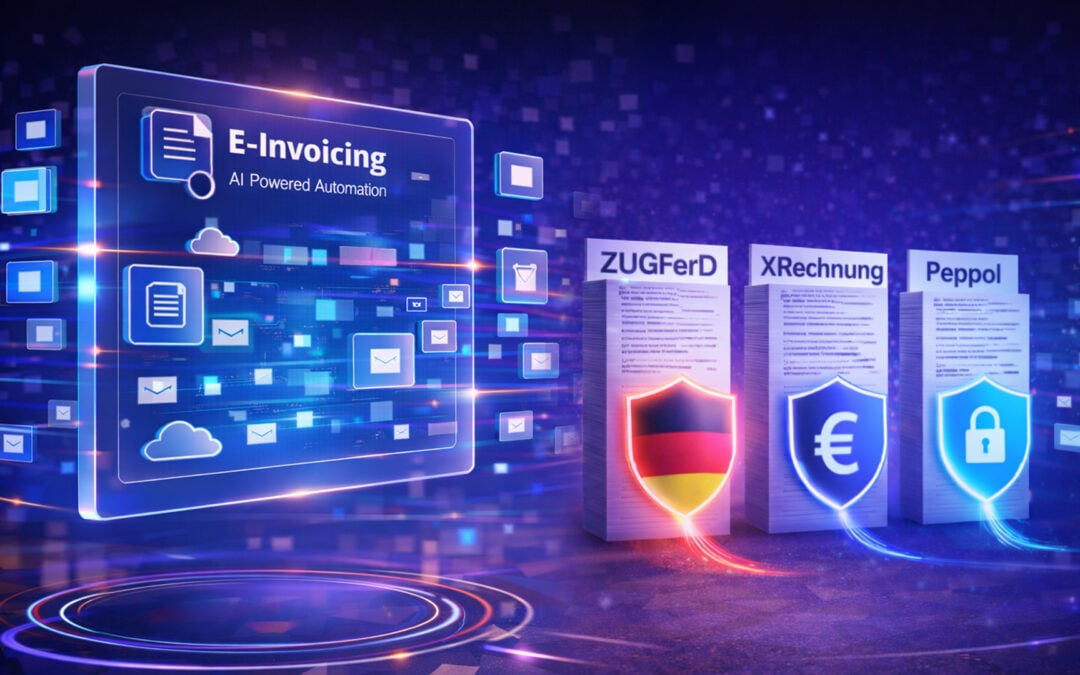
XRechnung is the official format for invoices sent to public contracting authorities in Germany. It is a purely structured XML format without a visual representation—people need special software to read XRechnung invoices. The format complies with EN 16931 and has been mandatory for public administration since 2020.
As a hybrid format, ZUGFeRD combines a human-readable PDF with embedded structured XML data. The advantage: Recipients can view the invoice as a PDF, while the system automatically processes the XML data at the same time. Starting with version 2.0.1, ZUGFeRD is also EN 16931-compliant.
Peppol is not a format, but a European network for electronic business documents—a digital highway for standardized exchange. The system uses certified access points as intermediaries and is particularly important for cross-border transactions. Furthermore, sending e-invoices via the Peppol network increases transparency compared to sending them by email, since the delivery status is tracked.
The practical question isn’t “Which format is the right one?” but rather “How can we flexibly handle all relevant formats?” After all, depending on the business partner and country, you’ll have to meet different requirements.
The Hidden Risks: What Happens If You Don’t Take Action?
Many companies underestimate the consequences of a lack of preparation. If your largest customers only accept e-invoices starting in 2027, but your systems can’t deliver, this jeopardizes the business relationship. For many corporations, e-invoicing capability is becoming a selection criterion for suppliers.
Invoices that do not comply with the required format will be rejected —resulting in delayed payments, disrupted cash flows, and increased administrative effort. Anyone who fails to meet the legal requirements risks penalties. The tax authorities can impose substantial fines for intentional violations. In addition, invoices that do not meet the formal requirements can result in the loss of input tax credits—which unnecessarily ties up liquidity.
While other companies are becoming more efficient through automated e-invoicing processes, you’re stuck in manual workflows. The gap in speed and cost structure grows wider every month.
The solution: A compliance partner who manages the complexity for you
With the right partner, this burden becomes an opportunity to optimize your processes. At Insiders, we understand the challenges faced by companies operating internationally. Our solutions, e-connect and e-convert, were developed as a central hub for all your electronic document exchange.
Format flexibility means that your system understands and processes every e-invoice format—entirely automatically. Whether your suppliers send XRechnungs, ZUGFeRD, or country-specific formats: The software automatically detects the format and converts it into a format your ERP system can understand. You always receive consistent, structured data. Sending invoices is also simplified—we automatically generate the formats your customers need from your outgoing invoices. Every invoice is checked for compliance in real time, and incorrect formats are detected immediately.
Portal integration gives you direct access to the digital ecosystem. As a certified Peppol partner, we act as your access point—you can exchange documents with all Peppol participants across Europe through us. We continuously monitor new national platforms and establish the technical connections so that you remain compliant at all times. Instead of juggling dozens of portals, you have a single, centralized interface.
You can ensure future-proofing through our ongoing monitoring of regulatory changes worldwide. When new requirements are introduced or validation rules change, we automatically apply updates. You benefit from these adjustments without having to do anything yourself and receive timely, proactive information about changes relevant to your business.
The Path to Compliance
Our collaboration begins with a detailed analysis of your current processes and the systems you use. Based on this, we develop a customized solution that integrates seamlessly into your existing IT landscape—whether SAP, Microsoft Dynamics, DATEV, or other systems. Following a pilot phase with selected business partners, the system is rolled out into production. Continuous optimization begins after go-live: the system learns with every invoice processed.
The measurable benefits for your company
A well-thought-out e-invoicing strategy delivers far more than just compliance. Automated processing significantly reduces manual effort, and invoices go through verification and approval in a much shorter time. Processing costs per invoice drop noticeably, and on top of that, you benefit from optimized cash discount utilization, avoided late-payment fees, and reduced archiving costs.
You’ll have complete transparency at all times regarding all incoming and outgoing invoices—regardless of the country of origin or file format. Thanks to faster, error-free processing, you pay on time and consistently take advantage of cash discounts, which strengthens your position as a reliable business partner. You automatically meet all current and future requirements and can provide complete documentation at any time during tax audits.
Real-world example: From format chaos to a centralized platform
A medium-sized manufacturing company with locations in Germany, Austria, and Switzerland, as well as suppliers from numerous countries, faced the challenge of a wide variety of invoice formats —ranging from paper to PDF to the first e-invoices. Each country had its own requirements, and the IT systems were not prepared for this.
Following the implementation of our e-invoicing platform as a central hub, all invoices now run through a single system—regardless of country or format. Automatic conversion, validation, and forwarding to the ERP systems have significantly reduced processing time, significantly reduced the error rate, and ensured full compliance in all countries. Today, the company is optimally prepared for future regulatory changes.
Conclusion: Make regulatory compliance a routine process rather than a risk
Mastering e-invoice formats is becoming a decisive competitive factor for international companies. Countries around the world are tightening their requirements, new formats are being introduced, and existing ones are evolving. The key question is not “if” but “how” you will navigate this transformation.
With Insiders as your strong compliance partner, the regulatory jungle becomes a predictable, efficient process. Format flexibility through automatic conversion, direct access to Peppol and national portals, continuous updates to ensure future-proofing—and a central platform for the entire document workflow.
At Insiders, we draw on our experience from numerous projects in manufacturing, retail, and other industries to meet your specific requirements as well. Let’s discuss how we can support you on your path to full e-invoicing compliance.
Ready for the next step? Contact us for a no-obligation analysis of your requirements.