
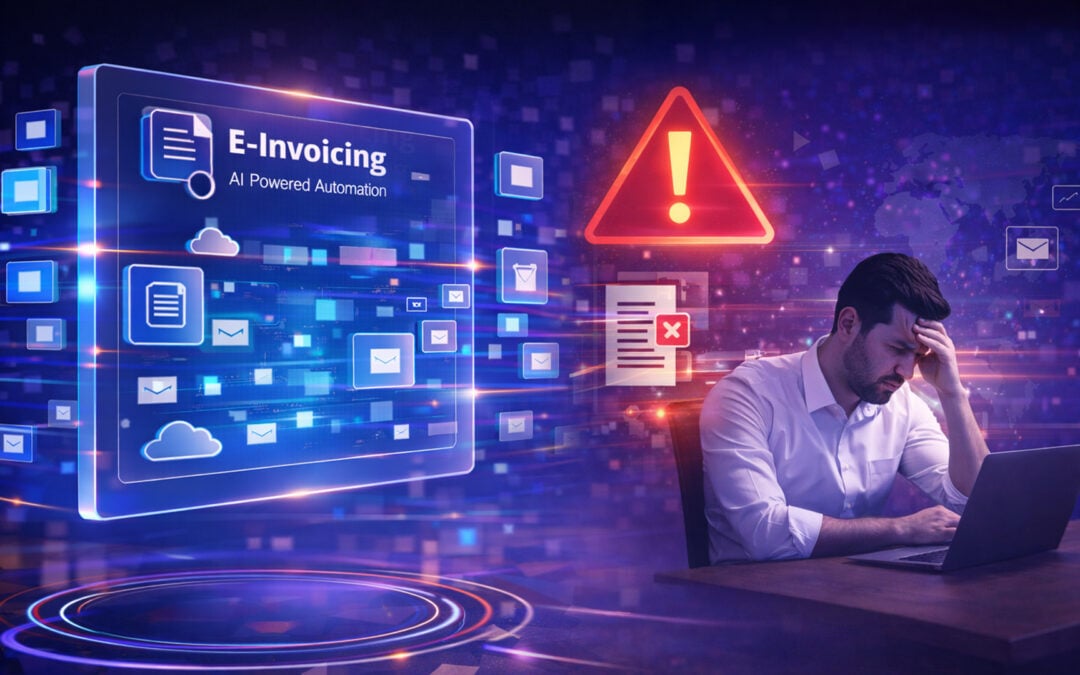
E-Invoicing: When Process Errors Become a Costly Trap
Why Proper Invoice Verification in Accordance with Section 14 of the German Value-Added Tax Act (UStG) Is Now More Important Than Ever —and how automated invoice processing with Insiders ensures the long-term security of your e-invoicing.
“It was just a minor number mix-up.” This statement can end up costing companies dearly. A single syntax error in the e-invoice, a missing mandatory field under §14 UStG, or an incorrect VAT ID can be enough to jeopardize the input tax deduction and lead to serious e-invoicing problems.
The reality in German finance departments: Erroneous invoices are piling up, manual corrections tie up valuable resources, and the costs quickly add up to six-figure amounts. For companies handling thousands of invoices per month, manual checks aren’t just time-consuming—they’re a risky source of errors that cost real money and can have legal consequences.
The Underestimated Risk: Why E-Invoicing Costs More Today Than Ever Before
Since January 1, 2025, stricter requirements for electronic invoicing in the B2B sector have been in effect. The Federal Ministry of Finance distinguishes between three critical types of errors: format errors, where the e-invoice does not comply with the structured format specified in EN 16931, business rule errors in the event of deviations from orders or terms and conditions; and content errors, where mandatory information required under §14 UStG is missing or incorrect.
Practical experience from the industry paints an alarming picture: In many ZUGFeRD invoices received via email, the technical headers are incorrect, and a significant proportion contains XML validation errors. This means that, out of every ten incoming e-invoices, often only two to three are technically correct and can be processed without any additional work.
The consequences for your e-invoicing compliance are severe. The loss of the input tax credit is the most common and most costly consequence. If an invoice does not meet the requirements, the tax office may deny the input tax credit. With an annual purchasing volume of 10 million euros and a 19 percent VAT rate, we’re talking about 1.9 million euros in input tax. Even if only 5 percent of the invoices are incorrect, 95,000 euros are at stake.
Added to this are fines of up to 5,000 euros per incident under Section 26a of the German Value-Added Tax Act (UStG), delayed processes with an average correction time of 8.5 days, and lost cash discounts. With a 2 percent discount and a purchasing volume of 10 million euros, every missed discount deadline results in a direct loss of up to 200,000 euros.
Why manual verification cannot guarantee secure e-invoicing
Typical error rates in manual invoice processing range from 5 to 15 percent. Out of 10,000 invoices, 500 to 1,500 contain errors that must be corrected. Each incorrect invoice results in an average of 15 to 25 euros in additional processing costs.
Let’s break this down: With 10,000 invoices per month and a moderate error rate of 10 percent, there are 1,000 erroneous invoices. Multiplied by an average correction cost of 20 euros, this amounts to 20,000 euros per month or 240,000 euros per year. And this example does not even take into account lost cash discounts, late fees, or the time spent on reconciliations.
The human eye is not designed to review hundreds of identical documents. An employee who manually reviews 50 to 80 invoices daily must check at least seven items per invoice: mandatory information pursuant to §14 UStG, VAT ID, invoice number, amounts, order reference, service description, and delivery date. With 60 invoices a day, that adds up to 420 individual checks—no wonder errors slip through and e-invoicing suffers.
The solution: Automated validation for seamless e-invoicing
Modern automation is changing the rules of the game. Instead of reactively correcting errors, you prevent them from the outset through systematic validation at multiple levels.
As soon as an e-invoice is received, the system automatically checks its syntax: Is the format EN16931-compliant? Is the XML structure valid? Are all technical headers present? Non-compliant invoices are immediately flagged and rejected—long before they enter the workflow. This initial check takes just milliseconds.
The second level is validation according to EN 16931. The system checks all 31 mandatory fields of the European standard to ensure that the data types are correct, that the codes used come from the defined lists, and that the mathematical calculations are accurate.
The most in-depth verification level is the compliance check in accordance with Section 14 of the German Value-Added Tax Act (UStG). Intelligent logic checks verify that the VAT ID matches the master data, verify the plausibility of the tax amounts, and reconcile them with order data and goods receipts.
The automated three-way reconciliation compares the invoice with the purchase order, goods receipt, and master data. Only when there is complete consistency is the invoice automatically approved for payment. Discrepancies are automatically flagged for clarification—in a targeted manner and with a specific indication of the problem. What takes 10 to 15 minutes to do manually is completed automatically in just a few seconds.
How Insiders Ensures the Long-Term Success of Your E-Invoicing
With our solutions, you can transform your finance department from an error-prone control unit into an efficient process hub.
Our AI-powered data extraction doesn’t just read data—it understands it. The system recognizes what information is located where on the invoice, whether the data is plausible, and which fields are missing or contain errors. The key difference from traditional OCR technology: Our system understands the context and continuously learns. Out of the box, our systems achieve recognition rates of over 70 percent. After an optimization phase, these rise to over 95 percent—with an error rate below 2 percent.
The multi-stage compliance engine systematically checks the syntax for compliance with standards such as XRechnung or ZUGFeRD, validates all required information in accordance with §14 UStG, and reconciles master data, order references, and calculated values. Each of these checks runs in milliseconds and provides specific error messages in case of discrepancies.
The intelligent workflow distinguishes between error types: Critical errors result in automatic rejection with a detailed note. Warnings flag the invoice for manual review. Valid invoices proceed directly to approval and payment—without any manual intervention. We achieve the “first-time-right” principle through supplier onboarding with clear format specifications, automatic feedback in case of errors, and continuous quality improvement.
The measurable benefits for your company
Companies with automated invoice processing achieve error rates of less than 2 percent—a reduction of up to 85 percent. This means fewer corrections, fewer follow-up inquiries, and less stress for the team. A concrete real-world example illustrates what this means in euros: A retail company processing 12,000 invoices per month reduced its error rate from 11 to 1.8 percent. Instead of 1,320 erroneous invoices, there are now only 216—a savings of over 1,100 error corrections per month. With average correction costs of 15 to 25 euros per invoice, this corresponds to a monthly cost reduction of 16,500 to 27,500 euros —solely due to the reduced rework. Extrapolated over the course of a year, this adds up to a sum in the high six-figure range, not including lost discounts and late-payment fees.
Through systematic validation, you minimize liability risks, secure input tax deductions, prepare optimally for tax audits, and reliably meet all legal requirements. The processing time per invoice is reduced by up to 90 percent. With 12,000 invoices per month and a time savings of 15 minutes per invoice, you save 3,000 work hours per month.
The savings are impressive: up to 70 percent lower processing costs per invoice, complete elimination of correction costs ranging from 15 to 25 euros per error, optimal use of cash discounts through faster processing, and avoidance of late fees. You’ll always have a complete overview of the status of every invoice, automatic reports on error rates, and a comprehensive audit trail for every transaction.
Practical Implementation: How to Get Started with Automation
We start with a thorough analysis of your current situation: How many invoices do you process each month? In what formats do you receive invoices? Where do most errors occur today? Based on this, we calculate your individual savings potential.
Based on this, we develop a customized solution with flexible integration into your existing system landscape, configuration of validation rules according to your specifications, and definition of approval workflows. The implementation of cloud-based solutions typically takes 8 to 12 weeks, allowing you to quickly benefit from the automation of your processes.
After go-live, optimization takes place—entirely automatically during ongoing operations. The system is constantly learning; we analyze the results together, and your error rate continues to drop steadily.
Future-Proofing: E-Invoicing for Upcoming Requirements
With the EU’s ViDA (VAT in the Digital Age) initiative and planned Continuous Transaction Controls, e-invoicing is becoming even more important. The EU plans to require all member states to transition to fully digital value-added tax systems by 2028. Those who rely on Insiders’ automated validation today are already meeting the upcoming requirements, are prepared for real-time-time reporting to tax authorities, and avoids costly adjustments down the line.
Investing in intelligent validation is therefore not just a compliance measure —it is a strategic decision for the future of your company.
Conclusion: Turn e-invoicing risks into competitive advantages
Process errors in e-invoicing are no trivial matter. They cost money, time, and patience—and, in the worst case, can lead to serious e-invoicing problems and fines. The good news: These risks can be systematically eliminated.
With intelligent automation and multi-stage validation, you can transform your invoice processing from a source of errorsinto an efficient, secure process. The error rate drops, e-invoicing in accordance with §14 UStG and EN16931 is guaranteed, cost savings of up to 70 percent are realistic, and you’ll be better prepared for future regulations. The ROI is typically achieved within 2 to 6 months.
Let’s discuss how we can transform your specific processes. Insiders has the experience gained from numerous projects across various industries to turn your challenges into measurable success. Turn your accounts receivable processing into a “first-time-right” process—secure, fast, and error-free.