Your P2P process needs a boost: What an AI agent needs to be able to do in procurement
Is your team still manually typing up order confirmations, resolving price discrepancies via email, and tracking approvals by hand? In recent years, many shared service centers have introduced initial AI capabilities in procure-to-pay (P2P), mostly for invoice capture or data extraction. Things get more challenging from there. Turning individual use cases into an end-to-end process in which AI agents take on real tasks is a different project altogether from the initial pilot.
What is an AI agent, in practical terms?
For a long time, the prevailing view was that a language model should have as much as possible “stored in its head.” This works only to a limited extent, because training data becomes outdated, specialized knowledge is missing, and when in doubt, the model simply makes a guess. An agent doesn’t have to know everything. It determines what information it needs for a task and goes out and gets it.
In purchasing, this means: It reads the order confirmation to determine what the order is for, and then looks it up in the purchase order, the supplier master, or the invoice data. It doesn’t stop at just providing an answer. It accesses the ERP system or triggers the next step in the process.
Still, it’s not an autopilot. When it’s unsure, a human makes the decision (“human-in-the-loop”). In Finance and Shared Services, this is usually the first question asked—and it’s a valid one.
Four Steps to an Agentic P2P Strategy
Hardly any company jumps straight to a fully automated process. A phased approach, in which responsibility gradually shifts from humans to agents, has proven effective:
- Individual use cases: AI reads and classifies documents, such as during invoice entry.
- Assistance: AI suggests an account assignment, vendor, or reason for a variance; the human makes the final decision.
- Individual agents: Agents handle defined subtasks independently and within clear rules.
- Agentic P2P: Multiple agents collaborate end-to-end, orchestrated and managed by the team.
Where agents are already working in P2P today
In invoice processing, AI captures invoices from all channels and checks them for required information and duplicates. The impact of this is reflected in processing times and the dark processing rate.
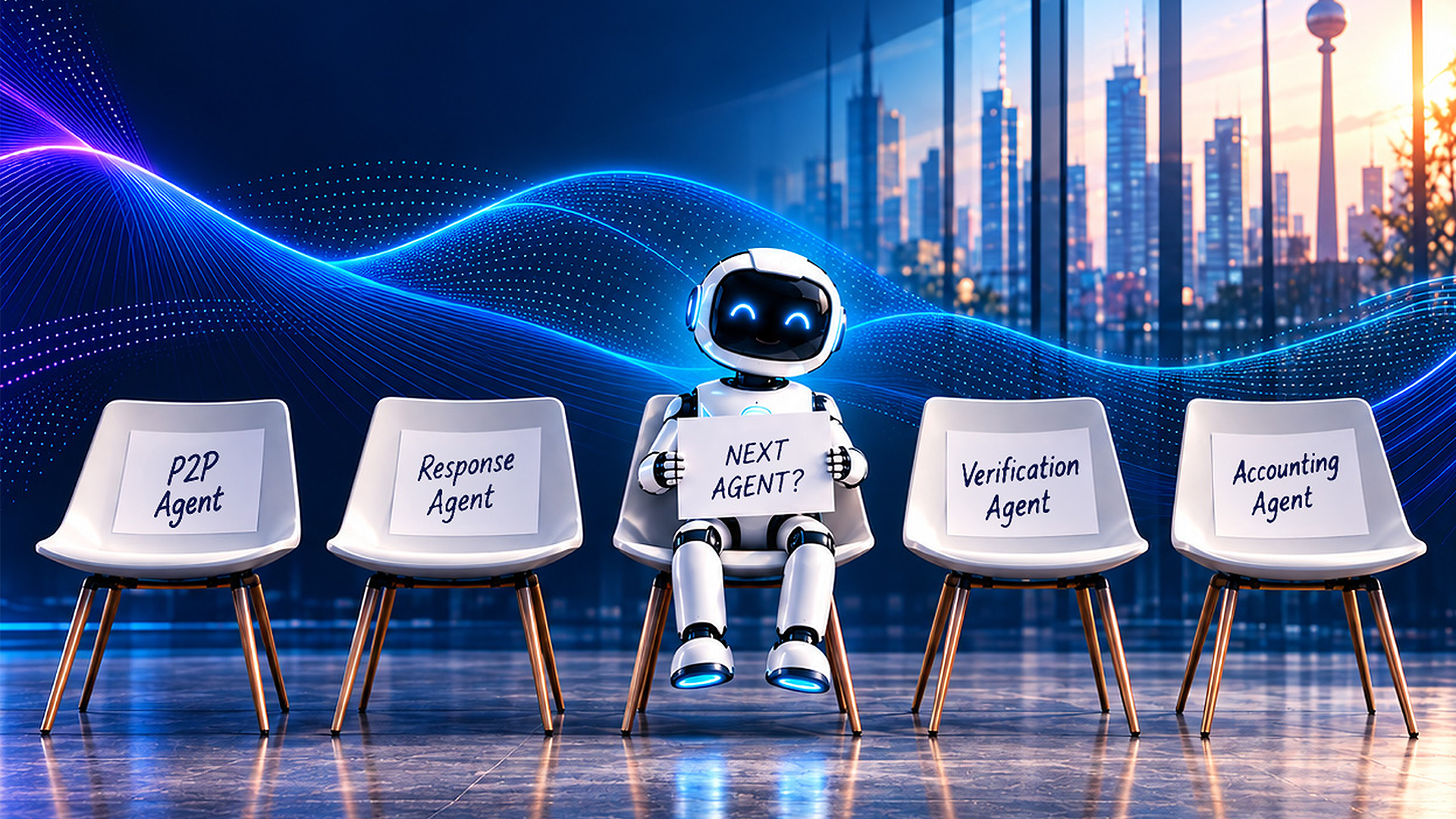
The Verification Agent reconciles invoices, purchase orders, and goods receipts and resolves discrepancies, resulting in reduced reconciliation effort and increased use of cash discounts.
Inquiries from suppliers regarding processing or payment status can also be answered automatically. Key metrics here are the number of inquiries processed per employee and the speed of responses. During approval and account assignment, the Accounting Agent suggests the appropriate general ledger account.
A metric from our OmnIA platform demonstrates just how much context matters. If the language model is also provided with master data, historical data, process information, and work instructions, the automated processing rate for invoices can more than double. In the next step, a Verification Agent works independently: they conduct research, verify their results in a feedback loop, and forward only the uncertain cases to manual verification.
In the workshop, we’ll demonstrate the Verification Agent for order confirmations live. It imports new confirmations, compares them with the purchase order, and forwards uncertain cases—along with an explanation—to the purchasing department. It sends messages to suppliers only after approval, and humans always make the final decisions regarding cancellations and replacement items.
The Resume of a Good Agent
A good agent in the P2P process is available immediately and 24/7. More important than technical expertise are soft skills: The agent treats similar cases consistently and justifies every decision. They know their limits and escalate issues rather than making guesses. They adhere to the dual-control principle and approval thresholds, handle financial and personal data with discretion, and learn from feedback.
What Causes Agent Projects to Get Stuck
Rarely because of AI technology—more often because of data. Master data that hasn’t been maintained in years, or missing interfaces between ERP, procurement, and document management. Before you roll out agents on a large scale, it’s worth taking an honest look at these questions:
- Are supplier and order data maintained in a way that an agent can work with them?
- Are there open interfaces to ERP, procurement, and document management, or are there siloed systems in place?
- Have approval thresholds been defined, and is it clear which exceptions require human intervention?
- Is every agent decision logged in an audit-proof manner?
- Does the team understand how its role is changing, and is it involved early on?
- Are the KPIs established before the project begins?
From Clerk to Agent Manager
With agents, roles within the team also change. Employees manage, train, and supervise agents and make decisions regarding exceptions and rules. Routine tasks are eliminated, leaving more time for supplier relationships and process improvement. Looking further ahead, agents will eventually communicate directly with agents from suppliers, banks, and platforms. That’s still a vision for the future. However, you can already lay the groundwork for it now—namely, well-maintained data, open interfaces, and clear approval rules.